In the lubricants industry, grease quality affects not only equipment performance but also brand reputation and the relationship between businesses and their customers. For distributors looking to develop their own brands, choosing an OEM grease manufacturing partner with strong technical capabilities and a transparent quality-control process is an important step.
What requirements must OEM lubricating grease meet to align with international standards? What factors should businesses consider when evaluating a grease manufacturer? This guide explains the role of ASTM test methods, ISO standards, NLGI classifications and certification programs—and the evidence a private-label business should request.
1. What is OEM grease, and why does product quality matter?
OEM grease is lubricating grease manufactured according to the requirements of the ordering business. These requirements may cover applications, technical properties, packaging specifications and private-label branding.
Instead of investing in their own factory and complete production system, businesses can partner with a contract manufacturer to develop products under their own brand names. This model is suitable for industrial lubricant distributors looking to expand their portfolios and gain greater control over their commercial strategies.
However, building a private-label brand involves more than designing attractive packaging or offering competitive prices. If product quality is inconsistent, businesses may struggle to retain customers and expand into new markets.
For this reason, businesses should define the product's technical requirements from the outset and agree with the manufacturer on test methods, acceptance criteria, documentation and procedures for maintaining consistency across production batches. See also our guide to private-label OEM grease manufacturing.
2. What do international standards mean in grease manufacturing?
When searching for an OEM manufacturer, businesses often look for ASTM and ISO standards, as well as classification systems and certifications used in the lubricating grease industry. Each has a defined scope and should not be treated as a complete substitute for another.
ASTM test methods
ASTM publishes test methods widely used to evaluate specific properties of lubricating grease. For example, ASTM D217 covers cone-penetration procedures used to measure grease consistency. Worked penetration results are used in the NLGI consistency classification.
ISO standards
ISO also publishes standards for grease testing and sampling. ISO 2137:2020 specifies methods for estimating the consistency of lubricating greases and petrolatum by measuring the penetration of a standardized cone. The standard was reviewed and confirmed in 2025, so the 2020 edition remains current.
NLGI classification and HPM certification
NLGI consistency grades classify grease by worked penetration; they do not by themselves demonstrate overall performance. NLGI's High-Performance Multiuse (HPM) program is different: it is a certification program built around a core specification, with enhancement tags for areas such as water resistance, high load-carrying capacity, salt-water corrosion resistance and low-temperature performance.
The key is to identify which standards, tests and certification requirements are appropriate for the intended application and target product. A product tested using an ASTM method does not automatically qualify as certified under every international standard.
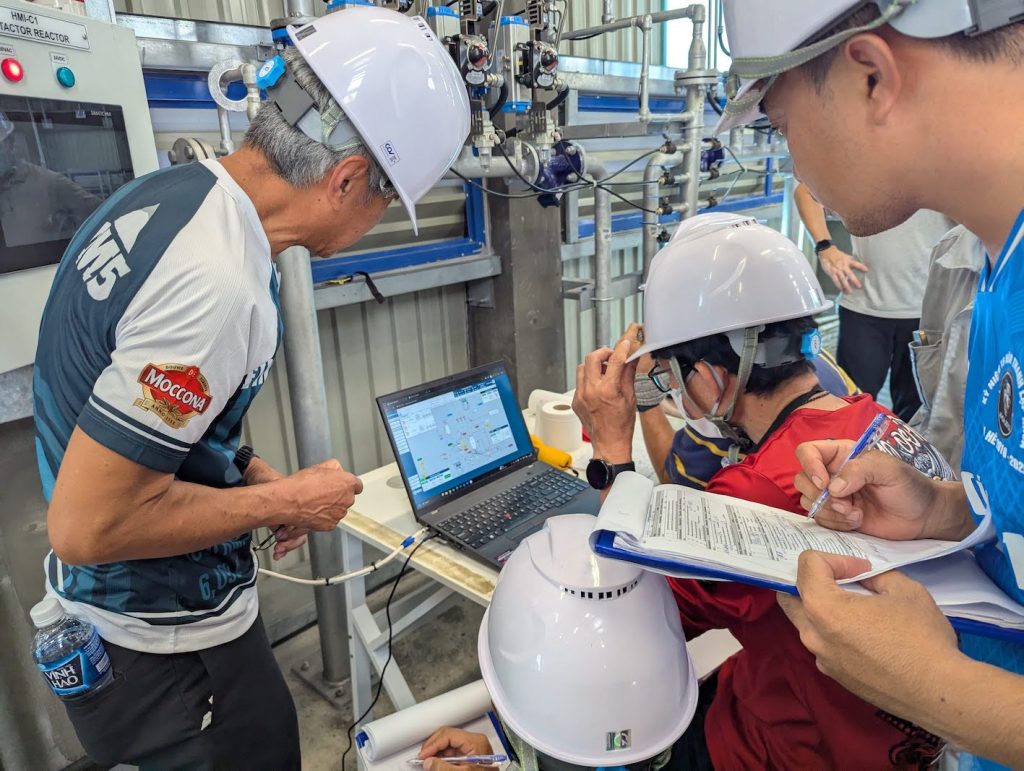
3. Key factors in maintaining OEM grease quality
Selecting suitable raw materials
Lubricating grease quality depends on the combination of base oil, thickener and additive system. Each component can affect properties such as consistency, load-carrying capacity, oxidation resistance, corrosion protection and performance in wet environments.
Raw materials should therefore be selected according to the product's technical requirements rather than price alone.
Controlling the manufacturing process
Manufacturing parameters can affect the structure and properties of the finished grease. Controlling operating conditions, mixing sequences and batch uniformity helps reduce the risk of quality variation.
A controlled manufacturing process should be supported by production records and inspection criteria appropriate to each product line.
Testing finished products against technical requirements
Depending on the grease type and application, relevant properties may include cone penetration, oil separation, mechanical stability, water resistance, corrosion protection and load-carrying performance.
Not every product requires the same set of tests. The manufacturer and ordering business should agree the key parameters based on the intended application, customer requirements and product specification. For a more detailed workflow, read our OEM grease quality-control process.
Managing packaging and batch traceability
Quality is not determined solely by the grease itself. Suitable packaging helps limit contamination, leakage and damage during storage and transportation. Product labels, batch codes and inspection records should also be managed clearly to support traceability if a quality issue arises.
Packaging requirements should be agreed alongside the technical specification. See our guide to OEM grease packaging design and coordination.

4. How should businesses evaluate an OEM grease manufacturer?
Before entering a partnership, businesses should assess the manufacturer's production capacity, product-development experience, quality-testing capability and transparency in maintaining technical documentation.
Key questions include:
- Which grease product lines and technical requirements can the manufacturer accommodate?
- Which parameters are checked for each production batch?
- Can the manufacturer provide quality documents or test results relevant to the product?
- What procedure applies when a product fails to meet the agreed requirements?
- Can the manufacturer support formulation adjustments, sample testing and private-label packaging development?
Businesses should review relevant documentation before making claims such as “compliant with international standards” or “certified.” Certification claims should only be made when valid documentation is available and applies to the specific product and scope concerned.
5. Benefits of an OEM partner with clear quality controls
For distributors, working with a technically capable manufacturer provides a more structured foundation for developing a private-label brand.
- Build a product portfolio around target-customer requirements instead of relying exclusively on brands already available in the market.
- Agree technical specifications and acceptance criteria to manage incoming product quality more effectively.
- Communicate more clearly with industrial customers using documented product requirements and test evidence.
- Focus resources on market development, distribution and customer service without building an entire manufacturing facility.
Nevertheless, OEM manufacturing does not automatically guarantee that a product meets every international standard. The outcome still depends on the technical requirements, the manufacturer's capabilities, the selected test procedures and the quality-control system applied to the specific product.
6. Quality assurance with OEMGrease.com
OEMGrease.com works with businesses in the lubricating grease sector that want to develop products under their own brands. Depending on the project's objectives and requirements, businesses can discuss product positioning, applications, technical properties, formulation development or adjustment, quality control and packaging specifications.
The cooperation process may begin with a review of customer needs, followed by defining product requirements, discussing technical options, conducting sample testing where necessary, agreeing inspection criteria and proceeding with production according to the agreed terms.
For businesses building their own grease brands, choosing an OEM partner should involve more than comparing manufacturing prices. Technical capability, transparent quality documentation and the ability to maintain a long-term working relationship are also important considerations.
Request an OEM Grease Consultation
Hotline: +84 916 33 77 00
Email: topsolutionsjsc@gmail.com