When specifying industrial grease, buyers commonly review NLGI consistency, base-oil viscosity, load-carrying capability, water resistance and dropping point. Dropping point is easy to compare, but it is also easy to misuse. A high value does not automatically mean that a product can run continuously near that temperature—or that it is the best grease for the application.
What is the dropping point of lubricating grease?
Dropping point is the temperature recorded in a standardized test when a heated grease sample undergoes sufficient structural change for a drop of material to fall from the test apparatus. It is usually reported in degrees Celsius.
The active wide-temperature-range method is ASTM D2265. The result is an artificially corrected laboratory number produced under the method's controlled conditions. It is best treated as a product-characterization and quality-control value.

Why is dropping point useful?
For grease manufacturers, formulators and technical buyers, dropping point can help:
- identify or compare greases of a similar type;
- establish and maintain production quality benchmarks;
- support assessment of the thickener system;
- check whether a batch remains within an agreed product specification; and
- provide one input—among many—when selecting grease for an application.
ASTM itself notes that dropping point has limited significance for service performance because it is a static test. This is the key distinction: the result describes behaviour in the test apparatus, not the complete behaviour of grease in a loaded bearing or other operating machine.
Is dropping point the maximum operating temperature?
No. Dropping point should not be used as the maximum operating temperature of a grease. NLGI's technical glossary likewise states that dropping point is not the melting point and should not be used to determine upper operating temperature.
Real high-temperature performance depends on the full formulation and operating environment, including:
- base-oil type and viscosity;
- thickener system;
- oxidation resistance and additive package;
- bearing speed and generated heat;
- load and vibration;
- water, dust and chemical exposure;
- duration of exposure to elevated temperature;
- relubrication interval and grease feed; and
- equipment condition and sealing.
How does the thickener system affect dropping point?
Lubricating grease is commonly formulated from base oil, a thickener and additives. The thickener forms the semi-solid structure that retains and releases oil at the lubricated contact. Different thickener chemistries produce different structural, thermal, water-resistance and mechanical properties.
A higher dropping point is therefore not a universal quality ranking. It indicates one aspect of the grease's structural behaviour under the stated test.
Lithium grease versus lithium-complex grease
Conventional lithium grease remains common across industrial and automotive applications because it can balance lubricity, mechanical stability and versatility. Lithium-complex grease is often developed for applications requiring a broader performance envelope, and its dropping point is typically higher.
That does not make lithium-complex grease automatically superior for every machine. Buyers should compare operating temperature, speed, load, water exposure, relubrication practice and compatibility with the grease already in service. Changing thickener systems without a compatibility review can create its own reliability risk.
What should buyers evaluate besides dropping point?
NLGI consistency grade
The NLGI grade describes grease consistency. The correct grade supports pumpability, retention and distribution in the intended equipment.
Base-oil viscosity
Base-oil viscosity strongly influences film formation. It should be selected in relation to speed, load, temperature and component geometry.
Load-carrying and wear protection
Heavy-duty applications may require appropriate extreme-pressure and anti-wear performance, verified by relevant specification and test data.
Water resistance and corrosion protection
Wet or wash-down environments require attention to water washout, water spray-off, rust protection and the grease's ability to remain in place.
Mechanical stability
Grease must maintain suitable consistency after repeated shearing and working. A dropping-point result does not show this behaviour.
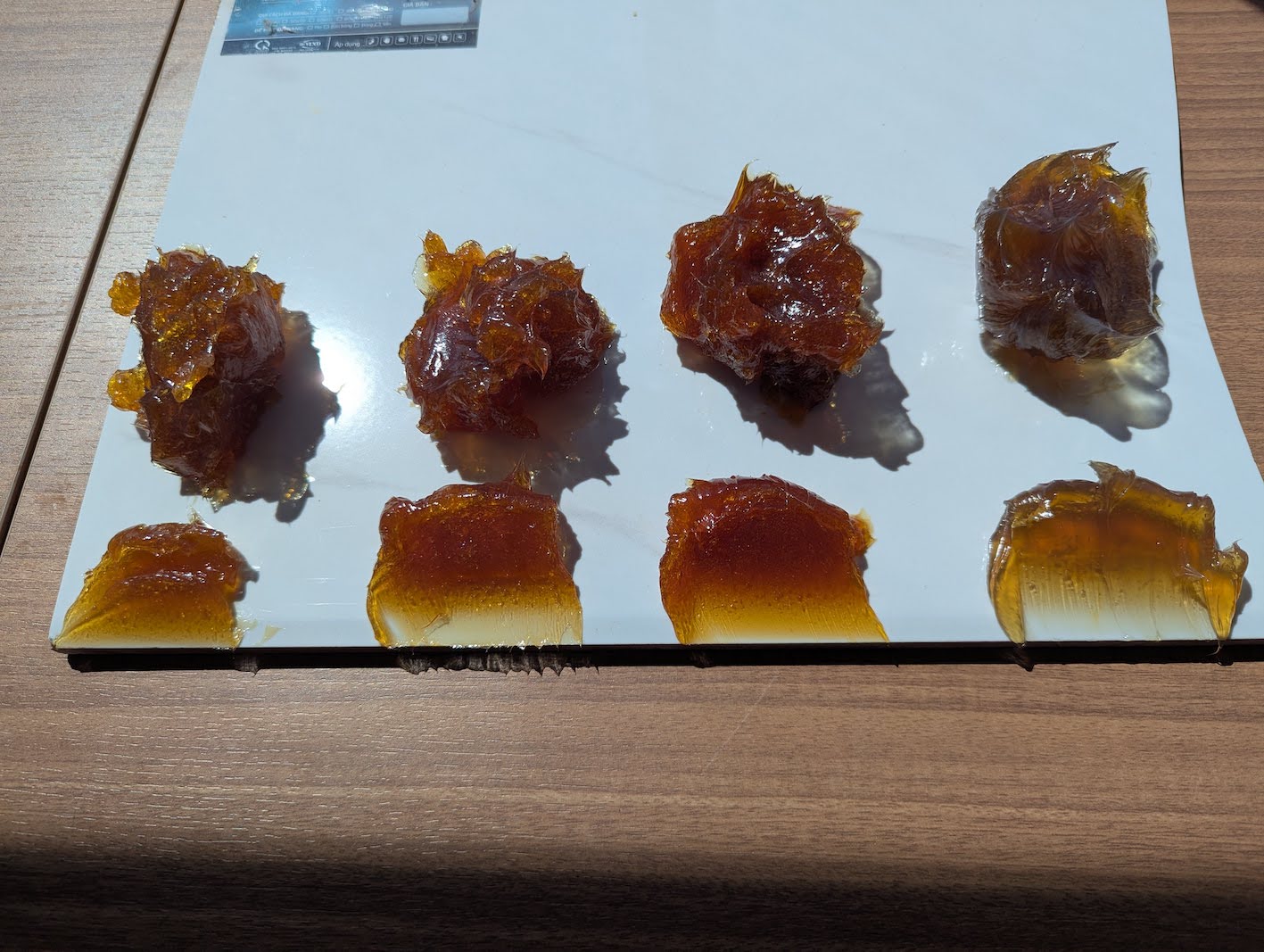
How is dropping point used in an OEM grease plant?
In an OEM manufacturing programme, dropping point may be included as a release or quality-control criterion where it is relevant to the agreed product specification. It is not used alone. Depending on the product, the quality plan may also cover worked penetration, base-oil viscosity, mechanical stability, oil separation, corrosion protection, water resistance, four-ball performance and other application-specific requirements.
For private-label grease, the customer and manufacturer should agree the technical specification before commercial production. This provides a clear basis for formula selection, sample approval, batch control and documentation.
Learn more about the quality-control process in an OEM grease plant and the role of a lubricating-grease quality-control laboratory.
What information should an OEM grease buyer provide?
To evaluate a suitable grease or develop a private-label product, provide the manufacturer with the equipment type, bearing or component, operating temperature, load, speed, environmental exposure, relubrication interval, current grease and any governing specification. This is more useful than requesting the highest possible dropping point without application context.
An OEM programme can then progress through requirement definition, formula selection or adjustment, sample production, testing, customer approval, packaging development and commercial manufacture. Read our guide to building a private-label grease brand.
Frequently asked questions
Is dropping point the same as melting point?
No. Lubricating grease is a structured semi-solid system, and NLGI specifically notes that dropping point is not the grease's melting point.
Can I compare any two greases by dropping point?
The value can support comparison, especially for similar grease types tested by the same method, but it should not replace a review of formulation, test method and application requirements.
Does a higher dropping point mean longer grease life?
Not necessarily. Grease life at elevated temperature is also influenced by oxidation, evaporation, oil separation, speed, load, contamination and relubrication practice.
Conclusion
Dropping point is a useful technical indicator for grease identification and quality control. It is not a stand-alone measure of overall quality and must not be treated as maximum operating temperature. A sound selection combines dropping point with base-oil viscosity, thickener chemistry, additives, consistency, mechanical stability and the actual operating conditions.
For OEM and private-label grease development, agreeing these requirements at the start creates a clearer technical specification and a stronger foundation for consistent production.
Request an OEM grease consultation
Technical references: ASTM D2265-22 and the NLGI Grease Glossary.